Thursday, April 19, 2012

Sycamore Warbler: Just like Tex said


   Last November, when I had Wayne County's first ever Rufous Hummingbird in my yard I had several local birders stop by to see it.  One gentleman who came by was 90 year-old Tex Wells. Tex has been one of the top state listers yearly since at least the late 1970's.  A state lister is a birder who tries to see as many species of birds in the state in a calendar year.  Here is a link to Scott Jennex's compilation of state and county lister records. 21th Annual Bird Compilation 2011  On page 23 of the document you'll find the annual State Big Year Records.  Tex has been  in the top 3 state listers every year except 1992. 

   So why am I name dropping Tex Wells( besides trying get people to read my blog)? While talking to him in my yard last November, he asked if I had ever had a Yellow-throated Warbler in my Sycamore trees.  I told him that I hadn't and he explained that they are sometimes called the Sycamore Warbler for their fondness of that tree species.   Fast forward five and a half months later and what do you know?  A Yellow-throated Warbler shows up in one of my Sycamores.  It stuck around for only a minute but long enough for me to get some halfway decent photos of it. 


  Yellow-throated Warbler is now species 117 on my backyard list.

Friday, April 6, 2012

Loon quest takes a Tern

   Early one overcast April morning two years ago, I stepped out my back door when I let my dog out for what dogs do every morning.  I instinctively scanned the skies as birders are prone to do.  When from the east came an unusually shaped bird having a sort of symmetry with black feet sticking out the back roughly the same distance its black head was protruding from the front.  Its white belly showing on every upstroke of its wings.  After a few minutes of flipping through some field guides I identified it as a Common Loon.  Not a bad yard bird for a densely populated suburban neighborhood.  Over the next 3 weeks I saw four more loons flyover.
  A year later right on schedule I had another Common Loon flyover on April 1.  That month between the 1st and 15th I saw 33 loons, with a high of 11 on the 7th.  Of course I had to try to photograph them. Wouldn't you know it on the days with decent lighting they were flying way up.

Exhibit 1.  


While on dreary, gray days they were flying  nearly straight overhead and low.

Exhibit 2.


   The quest for the perfect backyard loon photo resumed today.  We had perfectly clear deep blue skies but true to past experience the two loons I saw today flew so high I had to use binoculars to identify them and they were below the treeline before I could get the camera pointed at them.  The morning wasn't a total write-off though, because while I was taking test shots of gulls flying over making sure the camera settings were correct, I photographed this bird.


   A Caspian Tern.  A new bird for the yard list, number 116. 

  Update: April 9, 2012. I was able to get a better Loon flyby photo in good lighting.


  Totally unrelated bonus blog .
   Question : What is this?
A) a photo of the blue sky with a burned out pixel near the center.
B) a weather balloon at the edge of the atmosphere.
C) the planet Venus in broad daylight.


  Answer : C)   The planet Venus is the 3rd brightest object in the sky after the sun and moon.  It is bright enough to be seen with the unaided eye in daylight.  You just have to look in the exact right spot (at 4:30 pm today it was 71 degrees high just west of due south) in a transparent blue sky(binoculars help to find it initially).  In the heavily cropped inset photo taken this afternoon the shape of the 45% lit phase can be detected.


Friday, March 9, 2012

No Northern Lights

   On March 7th the Sun unleashed an X-5 class flare that had the potential to interact with the Earth's magnetic field and among other things create favorable conditions for a Northern Lights display.  Having the night off from work I was free to head out to Lenawee County to try to view and photograph a rare show.  Why Lenawee County?  It contains the nearest Dark Sky Preserve at Lake Hudson State Recreation area.  I packed up some photo gear and headed out there.
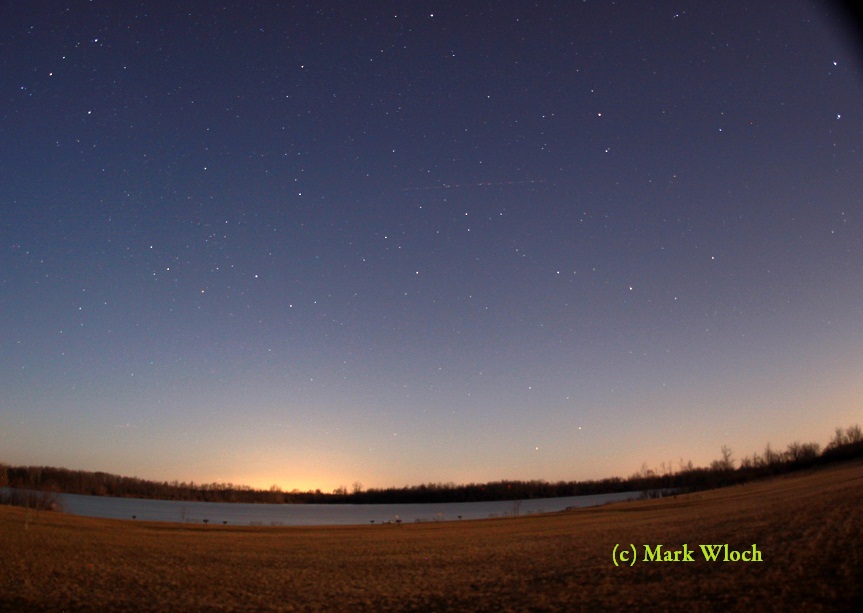
  The partly cloudy skies I saw at my house as I was packing, dissipated  during the 80 minute ride so that I was greeted by clear skies upon arrival at Lake Hudson.  I quickly set up and started experimenting to find the optimum camera settings. With a 15mm lens I was able to fit the constellations Orion, Taurus (including the Pleiades star cluster)


(L to R)Orion, Taurus, Pleiades, Jupiter and Venus
   
  One thing I had working against me was the full moon had just risen and decreased the contrast between the background sky and any celestial objects.  As the twilight faded as much as the moon would let it, it became apparent that the Aurora was not visible.  Sometimes an auroral display too faint for visual detection can be picked up by a camera.  I decided to aim the camera north to try my luck.


Polaris (North Star) near center at top.
    It was not to be.  My travel companion for the evening was my dog Roscoe.  What better foreground object in a photo of the constellation Canis Major (the Big Dog) than a Canis Lupus Familiaris (actual dog).   Little known fact is that Roscoe was Valedictorian of his obedience class by completing the command walkthrough  the fastest.  He may pull your arm off when going for a walk but he's a world-class 'stay-er'.

Roscoe sitting still for 13 seconds

Can you pick out Canis Major? It's to the upper left as indicated in the photo below.  It contains the brightest star in the sky, Sirius, the dog star.


Monday, February 27, 2012

Show Me Snow Geese

   Last November Tom Schlack, a birder on the Michigan birders listserve,  forwarded  a link to an online article about Snow Geese in Loess Bluffs NWR in Missouri. The article mentioned that up to 1,000,000 geese use the refuge as a staging area during their northerly spring migration. The accompanying photos were incredible. As a hack at both birding and photography I was intrigued to try to combine two of my interests in an opportunity that I couldn't screw up
   Now all I had to do was 1) monitor the refuge's website to see the totals of the waterfowl survey's  2) Hope for good weather for an 11 hour road trip that coincided with my days off.
  The stars aligned this past weekend as last Tuesday's survey indicated 1.2 million Snow Geese present and weather would be decent as long as I left Michigan early enough to duck south of developing winter storm in the upper midwest.  After a long day Thursday that consisted of an 8-hour shift and an 11-hour drive, I was at Loess Bluffs right after sunrise Friday morning and there they were, the largest group of Snow Geese I had ever seen(previous high was...1).

Snow Geese

    After marveling at the large gathering a local hunter told me he estimated that there were 400,000 in the lake and the rest would start coming back from the surrounding cornfields around midmorning. Then about 10 am, the geese start pouring out of the sky.

Snow Geese returning after breakfast


This seemed to continue unabated until about 2 pm.  By the time the influx ended there were at least 3 times more geese on the lake than there had been in the morning. 
   At first slowly, then more deliberately the birds started filing out of the lake for their evening meal. Here is a photo of the peak of the liftoff which was accompanied by a sound not unlike a home crowd roaring in response to a 99 yard last second winning touchdown.  When I got home and zoomed in on the full size version of this image I zoomed right in on a Ross's Goose.  Later it turned into bird nerd's equivalent of Where's Waldo to refind it.

mass liftoff of snow geese
After this mass liftoff I was hoping  for a colorful sunset against which I could photograph some goose V-formation silhouettes.  As luck would have it, the sun was being diminished by increasing cloud cover in advance of a wall of black clouds coming in from the north. What was lost in sihouettes against a fiery sunset was more than made up for by one of the most remarkable things I've ever seen.  The geese had taken off toward the black clouds and could be seen as at various distances as strings of white dots that moved in undulating waves.

Snow Geese heading toward black cloud.

Finally they all became white dots.


Snow Geese at a remarkable distance