Saturday, May 19, 2012

Day 2 in SE Arizona


 With my body still being on Eastern Daylight time, it was easy to not oversleep. I woke at 3:30am, and went outside to see how dark the Arizona skies were. The center of our Milky Way galaxy was visible to south in the constellations Sagittarius and Scorpio.


  As the dawn progressed I took off for Madera Canyon for more birding.  The Acorn Woodpecker in the top photo was photographed there. Here are a few other birds I saw there.


I also heard an Elegant Trogon up the trail but never got close enough to see it.


The magnificent, black chinned and broad-billed hummingbirds were all at the feeders at the Santa Rita Lodge on Madera Canyon Rd.


  Back in Patagonia, this  Lark Sparrow and Violet-Crowned hummingbird were in the yard at the Paton House, a world famous birding spot, known for its variety and volume of hummingbirds.


  I arrived back at the rental house 6 hours and 40 degrees later as the temperature had risen from a morning low of 47 degrees to 87 by 11:30am.


    .

Arizona Trip


 The trip begins.  Arrived home from work around 8:45am, finished packing, woke my daughter and hit the road by 9:15am.  A 14 hour ride fueled by Mountain Dew and Pepto Bismol had us pulling in to Tulsa, OK for the night.

  Day 2, drive was uneventful except for the heavy rain in the Texas panhandle that washed all the previous night's bugs off the windshield.  Late in the afternoon we reached Roswell, NM.  Something tells me we weren't the first visitors here.

   On Tuesday, we reached our first destination Patagonia, AZ. The house we rented was billed as a nature lovers paradise.  That it was.  The bird feeders had been filled in advance  of our arrival and we enjoyed the first chance on the trip to kick back and relax.  But how can you relax when the feeders, birdbaths and the trees were abuzz with birds.  Here are a few images I was able to capture.

Bridled Titmouse

     A humorous exchange took place between these two birds, when the Western Tanager took exception to the Black-headed Grosbeak arriving at the bird bath. The tanager kept squawking until the grosbeak got fed up and answered back and apparently had the last word. 


  Fortunately for me the tanager landed in a more picturesque setting.


  Here is a link to the Vacation Rentals by Owner listing for the house. http://www.vrbo.com/230952

Saturday, May 5, 2012

Monarch Egg


    On Wednesday May 2 I saw my first two Monarch Butterflies of the year, one during my lunch break at work and the second flying high over my yard after I got home.  That is definitely the earliest date I've ever seen them in Southeast Michigan. Those butterflies perhaps the second or third generation offspring of last autumn's Monarchs that migrated to and overwintered in Mexico.  The monarchs of spring and early summer are here for one reason.  Reproduce.  
     Today I inspected my 8" high Swamp Milkweed sprouts and found four freshly laid eggs.  After checking all the plants for eggs I noticed a female Monarch flying low over the milkweed patch.  I left her to do her duty.  A couple of hours later I rechecked the plants and I found 37 eggs.  Below are photos of one of the eggs which in a few days will hatch and begin the two week larval stage of its life. 


  Checking my old records the previous early date for finding monarch eggs in the yard was May 22, 2001.    


Tuesday, May 1, 2012

Scissor-Tailed Flycatcher

    Here are three photos I took today at Lower Huron Metropark near New Boston and Belleville, MI.  The bird was found by Nate Crawford, and the birding public alerted by Kevin Arnold and Paul Cypher.   Great bird and great job guys.  


Thursday, April 19, 2012

Sycamore Warbler: Just like Tex said


   Last November, when I had Wayne County's first ever Rufous Hummingbird in my yard I had several local birders stop by to see it.  One gentleman who came by was 90 year-old Tex Wells. Tex has been one of the top state listers yearly since at least the late 1970's.  A state lister is a birder who tries to see as many species of birds in the state in a calendar year.  Here is a link to Scott Jennex's compilation of state and county lister records. 21th Annual Bird Compilation 2011  On page 23 of the document you'll find the annual State Big Year Records.  Tex has been  in the top 3 state listers every year except 1992. 

   So why am I name dropping Tex Wells( besides trying get people to read my blog)? While talking to him in my yard last November, he asked if I had ever had a Yellow-throated Warbler in my Sycamore trees.  I told him that I hadn't and he explained that they are sometimes called the Sycamore Warbler for their fondness of that tree species.   Fast forward five and a half months later and what do you know?  A Yellow-throated Warbler shows up in one of my Sycamores.  It stuck around for only a minute but long enough for me to get some halfway decent photos of it. 


  Yellow-throated Warbler is now species 117 on my backyard list.

Friday, April 6, 2012

Loon quest takes a Tern

   Early one overcast April morning two years ago, I stepped out my back door when I let my dog out for what dogs do every morning.  I instinctively scanned the skies as birders are prone to do.  When from the east came an unusually shaped bird having a sort of symmetry with black feet sticking out the back roughly the same distance its black head was protruding from the front.  Its white belly showing on every upstroke of its wings.  After a few minutes of flipping through some field guides I identified it as a Common Loon.  Not a bad yard bird for a densely populated suburban neighborhood.  Over the next 3 weeks I saw four more loons flyover.
  A year later right on schedule I had another Common Loon flyover on April 1.  That month between the 1st and 15th I saw 33 loons, with a high of 11 on the 7th.  Of course I had to try to photograph them. Wouldn't you know it on the days with decent lighting they were flying way up.

Exhibit 1.  


While on dreary, gray days they were flying  nearly straight overhead and low.

Exhibit 2.


   The quest for the perfect backyard loon photo resumed today.  We had perfectly clear deep blue skies but true to past experience the two loons I saw today flew so high I had to use binoculars to identify them and they were below the treeline before I could get the camera pointed at them.  The morning wasn't a total write-off though, because while I was taking test shots of gulls flying over making sure the camera settings were correct, I photographed this bird.


   A Caspian Tern.  A new bird for the yard list, number 116. 

  Update: April 9, 2012. I was able to get a better Loon flyby photo in good lighting.


  Totally unrelated bonus blog .
   Question : What is this?
A) a photo of the blue sky with a burned out pixel near the center.
B) a weather balloon at the edge of the atmosphere.
C) the planet Venus in broad daylight.


  Answer : C)   The planet Venus is the 3rd brightest object in the sky after the sun and moon.  It is bright enough to be seen with the unaided eye in daylight.  You just have to look in the exact right spot (at 4:30 pm today it was 71 degrees high just west of due south) in a transparent blue sky(binoculars help to find it initially).  In the heavily cropped inset photo taken this afternoon the shape of the 45% lit phase can be detected.


Friday, March 9, 2012

No Northern Lights

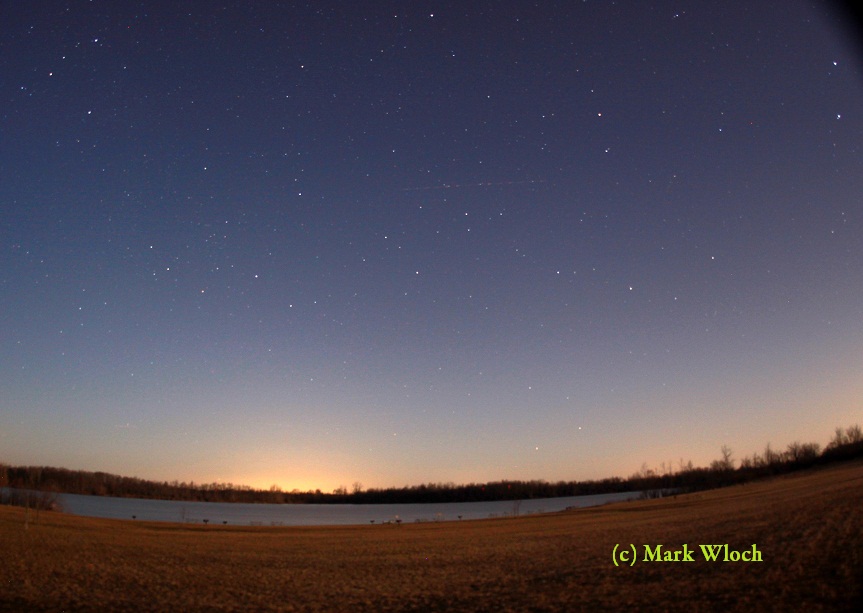
   On March 7th the Sun unleashed an X-5 class flare that had the potential to interact with the Earth's magnetic field and among other things create favorable conditions for a Northern Lights display.  Having the night off from work I was free to head out to Lenawee County to try to view and photograph a rare show.  Why Lenawee County?  It contains the nearest Dark Sky Preserve at Lake Hudson State Recreation area.  I packed up some photo gear and headed out there.
  The partly cloudy skies I saw at my house as I was packing, dissipated  during the 80 minute ride so that I was greeted by clear skies upon arrival at Lake Hudson.  I quickly set up and started experimenting to find the optimum camera settings. With a 15mm lens I was able to fit the constellations Orion, Taurus (including the Pleiades star cluster)


(L to R)Orion, Taurus, Pleiades, Jupiter and Venus
   
  One thing I had working against me was the full moon had just risen and decreased the contrast between the background sky and any celestial objects.  As the twilight faded as much as the moon would let it, it became apparent that the Aurora was not visible.  Sometimes an auroral display too faint for visual detection can be picked up by a camera.  I decided to aim the camera north to try my luck.


Polaris (North Star) near center at top.
    It was not to be.  My travel companion for the evening was my dog Roscoe.  What better foreground object in a photo of the constellation Canis Major (the Big Dog) than a Canis Lupus Familiaris (actual dog).   Little known fact is that Roscoe was Valedictorian of his obedience class by completing the command walkthrough  the fastest.  He may pull your arm off when going for a walk but he's a world-class 'stay-er'.

Roscoe sitting still for 13 seconds

Can you pick out Canis Major? It's to the upper left as indicated in the photo below.  It contains the brightest star in the sky, Sirius, the dog star.